
Research Article
First published: 16 August 2021
Abstract
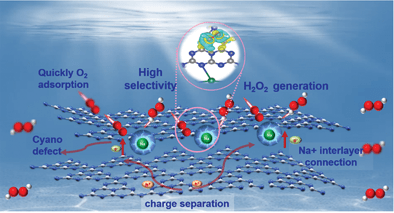
The demands for green production of hydrogen peroxide have triggered extensive studies in the photocatalytic synthesis, but most photocatalysts suffer from rapid charge recombination and poor 2e- oxygen reduction reaction (ORR) selectivity. Here, a novel composite photocatalyst of cyano-rich graphitic carbon nitride g-C3N4 is fabricated in a facile manner by sodium chloride-assisted calcination on dicyandiamide. The obtained photocatalysts exhibit superior activity (7.01 mm h-1 under ? >= 420 nm, 16.05 mm h-1 under simulated sun conditions) for H2O2 production and 93% selectivity for 2e- ORR, much higher than that of the state-of-the-art photocatalyst. The porous g-C3N4 with Na dopants and cyano groups simultaneously optimize two limiting steps of the photocatalytic 2e- ORR: photoactivity, and selectivity. The cyano groups can adjust the band structure of g-C3N4 to achieve high activity. They also serve as oxygen adsorption sites, in which local charge polarization facilitates O2 adsorption and protonation. With the aid of Na+, the O2 is reduced to produce more superoxide radicals as the intermediate products for H2O2 synthesis. This work provides a facile approach to simultaneously tune photocatalytic activity and 2e- ORR selectivity for boosting H2O2 production, and then paves the way for the practical application of g-C3N4 in environmental remediation and energy supply.
Research data are not shared.