
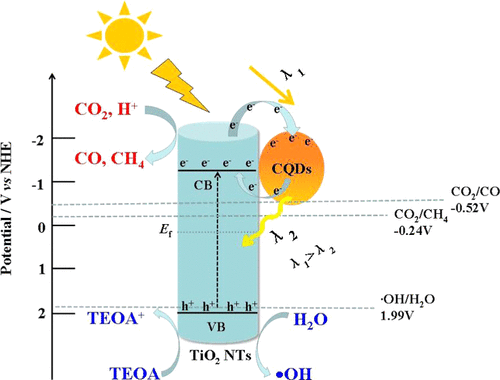
As a greenhouse gas, the efficient conversion of carbon dioxide (CO2) into fuel by the photocatalytic technology is one of the feasible ways to promote sustainable energy development and achieve global energy demand. In this work, with special optical absorption and fluorescence emissions, biomass-derived carbon quantum dots (CQDs) are used to modify TiO2 nanotubes (NTs) for the enhancement of photocatalytic CO2 reduction. Monodisperse CQDs have a diameter of 2-5 nm and are loaded on TiO2 NTs, which are confirmed by various characterizations. Compared with TiO2 NTs, the as-prepared CQD-modified TiO2 NTs exhibit the significantly enhanced photocatalytic properties of CO2 reduction under irradiation. And the composite photocatalyst obtained by the combination of 10 mL of CQD solution with TiO2 NTs exhibits the highest CO2 photoreduction with the CO and CH4 yields of 13.55 and 3.54 umol.g-1, which are 2.4 and 2.5 times that of TiO2 NTs, respectively. The higher CO2 photoreduction is ascribed to the introduction of CQDs into TiO2 NTs. Moreover, biomass-derived CQD-modified TiO2 NTs exhibit satisfactory stability for CO2 reduction. The encouraging photocatalytic performance for CO2 conversion exhibits that TiO2-based composites modified by carbon materials provide a feasible route to improve CO2 reduction utilizing abundant solar energy.
[ASAP] Interface Modification of TiO2 Nanotubes by Biomass-Derived Carbon Quantum Dots for Enhanced Photocatalytic Reduction of CO2
Author:
Category: