
As much as one-fifth of carbon offset units issued by the federal government under its Emissions Reduction Fund may have no basis in emissions reductions, new research has found.
A joint report published by the Australian Conservation Foundation and The Australia Institute has raised serious questions around the ‘avoided deforestation’ methodologies under the federal government’s ERF, the mechanism it introduced after scrapping Labor’s economy-wide carbon price.
The avoided deforestation methodology allowed under the ERF – which issues credits for claimed emissions reductions – is founded on commitments from landholders not to exercise their right to clear land of vegetation.
Under the ERF, Australian Carbon Credit Units (ACCUs) are awarded to landholders who make such commitments, on the basis that carbon will remain stored in forests rather than being released into the atmosphere as a result of land clearing.
But the new research suggests that much of the land subject to ‘avoided deforestation’ agreements would never have been cleared of vegetation and the carbon offsets issued to such projects are largely fictional.
Around 22 million of the 100 million ACCUs issued to date have been awarded to ‘avoided deforestation’ projects, and the research raises fresh doubts around the integrity of one of the Morrison government’s core policies designed to achieve its emissions reduction targets.
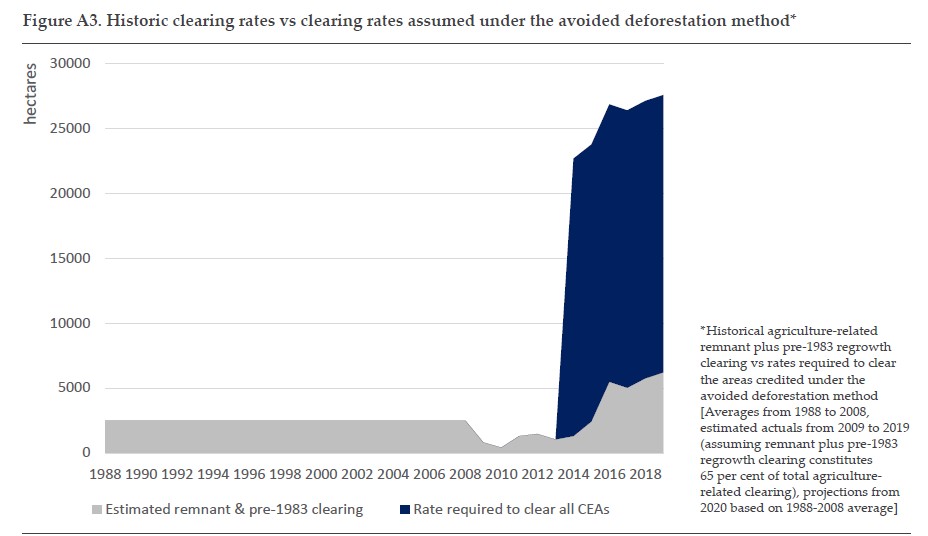
The study examined historical land clearing rates across New South Wales, finding that land clearing rates would need to rise dramatically above their historical levels – as much as 129 times greater than the historical average – to allow all of the permits to be used.
It suggests it is implausible that the vast majority of the land clearing permits could ever have been exercised, and so only a small proportion of emissions have actually been avoided.
Not only is it unlikely that land clearing would ever have occurred on land awarded carbon credits, the study also found that the rate of land clearing since the creation of the Emissions Reduction Fund has increased.
It suggests that the Emissions Reduction Fund has not delivered real reductions in land clearing and that it is implausible that many of the ACCUs issued for ‘avoided deforestation’ actually represent a substantive reduction in emissions.
The Morrison government is relying on the Emissions Reduction Fund to deliver a significant portion of the carbon abatement needed to reach its 2030 emissions target.
In 2019, the Morrison government poured an additional $2 billion into the ERF, which it expects could deliver an additional estimated 100 million tonnes of emissions reductions or around one-third of the reductions needed to reach that 2030 target.
The Morrison government has contracted to purchase 26.3 million ACCUs from avoided deforestation projects at an estimated cost of $310 million.
Following the publication of the new research into the integrity of the scheme’s abatement methodologies, The Australia Institute and the Australian Conversation Foundation have called for the avoided deforestation methodology to be revoked.
“Revoking the method will prevent the registration of new avoided deforestation projects. However, it will not stop existing projects from continuing to receive ACCUs over the remainder of their 15 year crediting period,” the report says.
“To prevent more government and private money from being wasted on low integrity credits, steps should be taken to stop the existing projects from receiving any further ACCUs.”
“At the very least, the Australian Government should take steps to warn companies and individuals that buy ACCUs of the integrity problems with avoided deforestation projects and the risk that the ACCUs do not represent real and additional abatement.”
The Australia Institute’s climate and energy program director, Richie Merzian, said the new analysis raised serious questions about the integrity of the federal government’s Emissions Reduction Fund.
“The lack of integrity relating to Australia’s carbon abatement methods calls into question the overall value of the ERF and its success as a mechanism to help Australia meets its climate targets,” Merzian said.
“There is legislation in place that requires landholders not be paid to avoid emissions that were never going to be generated. The Australian government has failed to ensure that requirement has been met.”
“Just as it would be a poor use of taxpayer funds to pay non-smokers to stop smoking, this method of accounting sees taxpayer dollars paying to retain vegetation that was never going to be cleared. Our research shows that many of Australia’s carbon credits could be little more than hot air,” Merzian added.
Lead environmental investigator at the Australian Conservation Foundation, Annica Schoo, said that the environmental group had raised the issue with the government’s Emissions Reduction Assurance Committee, but no action has been taken.
“The Emissions Reduction Assurance Committee exists purely to ensure the integrity of the ERF. In 2019, we wrote to the Committee raising serious concerns about the integrity of the methods and the ERAC conducted a review. What happened to the review?” Schoo said.
“Our findings demonstrate that the avoided deforestation method—which makes up one in five of all Australian carbon credits—is deeply flawed. The Committee’s review should have reached this conclusion at the beginning of the Morrison Government’s term.”
“The Morrison Government should be embarrassed by its flagship climate policy. Australians want real climate action, not cheap tricks and hot air,” Schoo added.
The analysis comes just weeks ahead of international climate talks to be held in Glasgow. The Morrison government is likely to talk up the Emissions Reduction Fund as a key contributor to Australia’s emissions reductions while refusing to commit Australia to stronger targets.