
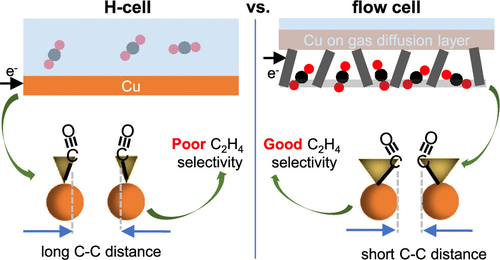
The implementation of an electrochemical flow cell has enabled improved efficiency for CO2 reduction. However, in situ spectroscopic insights into the interface are still lacking. Here, we investigate a series of copper layers with different thicknesses on gas diffusion electrodes as a benchmark, with the best-performing one showing a Faradaic efficiency of 59.5% and a partial current density of -170 mA cm-2 for ethylene formation in 1 M KOH at -0.70 V against a reversible hydrogen electrode. By comparing the geometric as well as specific current density for ethylene on four Cu catalysts with different thicknesses, we illustrate the effects of bulk pH, local pH, and diffusion of CO2 on C-C coupling. We also reveal that the flexible rotation of the Cu-C bond of the *CO intermediate adsorbed on Cu, as shown by in situ Raman spectroscopy, is likely to be the key factor for efficient C-C coupling in a flow cell.
[ASAP] New Insights into the Interface of Electrochemical Flow Cells for Carbon Dioxide Reduction to Ethylene
Author:
Category: