
Synopsis
This article presents the most detailed blueprint for China to meet its greenhouse mitigation goals using CCUS technologies in its coal-fired power sector.
Carbon dioxide (CO2) emissions are of global concern for climate change. Coal use is the largest source of CO2 emissions globally and in China. Many greenhouse gas emission reduction strategies target a phase-out of coal power, and coal use is declining in some countries owing to the combined effect of stricter environmental regulations and increasingly cost-competitive alternatives for power generation from low-carbon and renewable sources.(1,2) Despite commitments to coal phase-outs from many developed countries around the world, coal-fired power generation reached a record of 10 00 TWh in 2018, representing an increase of 3% over the prior year.(1,2) Coal remains firmly in place as the most significant power source around the world–38% of overall generation–and especially in China.(1) China’s abundant domestic coal production has been a primary factor in its rapid economic growth. Coal is forecast to remain its dominant energy source through the 21st century given significant coal reserves and the nation’s massive investment in coal-fired infrastructure.(3,4) Total power generation in China increased from 1347 TWh in 2000 to 7487 TWh in 2019 with an average annual growth rate of more than 10%,(5) and it is predicted to be more than 15 000 TWh in 2050. China has the world’s largest installed capacity of coal-fired power at 1191 GW and coal-fired power generation of 5220 TWh in 2019, which accounts for two-thirds of its total electricity generation.(5) Natural gas power is only a very small fraction (less than 5%) of thermal power in China in 2018. Reliance on coal-fired power has led China to top the list of CO2-emitting nations at nearly 10 billion tonnes in 2017,(6) with a calculated 3.7 billion tonnes from the coal power sector based on provincial data published by the National Bureau of Statistics.(5) Although the Central Government has been investing heavily in the deployment of renewable wind and solar power and highly efficient fossil-fuel utilization systems, as well as restricting the growth of new coal-fired plants, coal power remains dominant in China with gradually increasing capacity and CO2 emissions.(5) Therefore, reducing the CO2 emissions of existing coal plants will be vital for China to achieve mitigation targets,(4) including the carbon peak by 2030 and the ambitious new target of becoming carbon neutral by 2060.(7)
Among various mitigation approaches, carbon capture, geological utilization, and storage (CCUS) technology is crucial for addressing existing and future coal use,(8) and prior work suggests its importance in application to the coal power sector in China.(9-11) Although components of CCUS infrastructure are technologically mature, there are still only 19 large-scale full chain CCUS projects in operation globally.(12) Several pilot- or demonstration-scale CCUS projects have been achieved in different industry sectors in China; however, large-scale deployments are lagging other nations, especially in the coal power sector.(13) The primary reason for this lag is that CCUS technology has to date been defined as an “alternative technology” by the Central Government in China. The alternative technology means that the technology is at the stage of R&D, and it is the last choice when we must use it to mitigate climate change. Stakeholders in China–including enterprise owners, policy decision-makers, and the public–generally regard CCUS as a technology of relatively high cost and risk. Therefore, robust techno-economic evaluation and engineering verifications at scale are crucial for addressing stakeholders’ negative perceptions of CCUS technology, which have not been performed previously.
CCUS techno-economic assessments have been carried out for various technology components, regions, and power plants in China, but the results vary significantly depending on the level of detail and underlying assumptions.(10,14-19) One-size-fits-all assessments are too simplistic to be accepted by a broad community of stakeholders. Further, detailed costs of integrated CCUS projects, especially in the areas of CO2 pipeline transport and geologic storage, remain uncertain and to date have been treated as simple fixed costs without suitable technical assessments.(3,20-24) Meanwhile, national-scale evaluation of CCUS retrofits in China’s coal power sector is rare. The lack of a robust, national-scale techno-economic assessment of CCUS deployment has contributed to the fact that a commercialization strategy is largely missing from the low-carbon energy mix in China.(25)
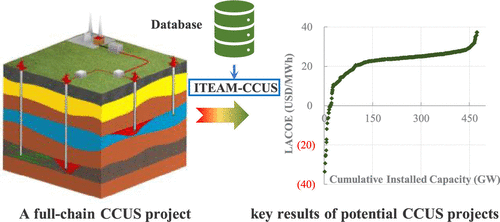
In this study, we developed a bottom-up Integrated Techno-Economic Assessment Model of CCUS (ITEAM-CCUS) to enable a novel assessment of deploying CCUS technology in the coal power sector across China. This prefeasibility level approach includes power plant screening and selection, suitability evaluation of storage sites at sub-basin scale, budgetary techno-economic modeling of integrated CCUS projects, cost curve by source-sink matching, and the inventory of possible integrated CCUS projects.(26) The evaluation is unique for the national-scale assessment of full-chain CCUS projects at an unprecedented level under actual conditions. Model results are derived through the application of ITEAM-CCUS to the most comprehensive database of relevant techno-economic parameters ever assembled for China. The unique database developed from this work is open for stakeholders to use in a subsequent analysis of CCUS potential at various scales.
The integrated techno-economic assessment model of CCUS technology (ITEAM-CCUS) considers key attributes of each CCUS retrofit, such as avoidance costs, levelized costs, levelized additional costs of each retrofit, energy penalty, site risk, and the spatial distribution of matched CO2 sources and geologic sinks for subsurface carbon storage. This approach includes power plant screening and selection, suitability evaluation of storage sites, techno-economic modeling of integrated CCUS projects, cost curve development, and the inventory of possible integrated CCUS projects.(26) The procedure broadly follows the framework outlined previously by Li, Wei, Jiao, Liu, and Dahowski.(26) Important improvements and updates have been made to reduce the uncertainties inherent in earlier work, including the technical design of the full-chain CCUS project, geological site selection and performance evaluation, budgetary techno-economic modeling, and source-sink matching modeling.(26-29)
The Technical Scheme of Integrated CCUS Projects
The new ITEAM-CCUS modeling is based on the current best available technologies (BATs) with high technology readiness levels (TRLs), long history of application, abundant equipment suppliers, relatively high transparency of cost, and economic advantages. A diversity of CO2 capture technologies has been evaluated by researchers around the world in the past, which are grouped into three main categories: precombustion, oxy-fuel combustion, and postcombustion capture (PCC). Presently, amine-based PCC is one technology among BATs.(18,31) The levelized costs of amine-based capture projects in China range from 30 to 50 USD/t.(13) Therefore, the use of amine-based PCC technology is assumed for CO2 capture as the reference for the techno-economic analysis since other capture technologies are still in the pilot-scale development phase.(23) Steam requirements for the solvent regeneration in the capture system are obtained from the steam turbine with intermediate to low pressure crossover, and the thermal load of solvent regeneration can be converted to an equivalent electrical load through a coefficient of performance.(31) In the design of CCUS retrofits, the bypass design is adopted for partial CO2 capture because of its cost-effectiveness in amine-based PCC systems. Gas power generation is less than 5% of thermal power generation in China; meanwhile, the CCUS retrofits to natural gas power plants are slightly different from that to coal-fired power plants. Therefore, gas power generation is not analyzed in this paper. The preferred option for large-scale transportation is pipeline using supercritical or dense-phase CO2. The typical levelized costs of supercritical or dense-phase CO2 pipeline transportation range from 0.02 to 0.07 USD/t.km.(13,28)
Among various options for CO2 geologic utilization and storage, CO2-enhanced crude oil recovery (CO2-EOR) and CO2-enhanced water recovery with saline aquifer storage (CO2-EWR/storage) can provide additional oil recovery and water resources with CO2 mitigation at relatively low cost and high TRLs.(32) The levelized costs of CO2 aquifer storage demo-scale projects in China were assessed in a range from 1 to 8 USD/t; and levelized costs of CO2-EOR were assessed in a range of from -100 to 60 USD/t.(13,29) The CO2-EOR and CO2-EWR/storage processes share many similarities, such as how subsurface storage capacities are greatly influenced by the production of native fluids in the reservoir (e.g., hydrocarbons and aqueous solutions) and complex migration patterns of CO2 caused by various physical and chemical mechanisms in heterogeneous formations such as reservoir sweeping processes, solubility, and chemical reactions.(33,34) Coupling projects with CO2-EOR and CO2-EWR/storage can benefit the dynamic demand of CO2 in oil reservoirs through the buffering effect of CO2-EWR and infrastructure sharing to optimize the overall capacity factor and decrease the costs of full-chain CCUS projects.(35) The preferential use of oil reservoirs and the coupling of storage projects are assumed in this assessment. Total storage capacity in oil fields was assessed by proved original oil-in-place and found to be insufficient for mitigation of all coal plant CO2 emissions in China. Therefore, plants without coupling projects were assumed to use saline aquifer sites for geologic storage. shows the major technical features and parameters of full-chain CCUS projects assumed in this assessment. In the process of an integrated CCUS project, CO2 from flue gas of pulverized coal plants is captured by an amine-based PCC technology, then compressed for pipeline transport to selected oil fields and nearby saline aquifer sites for CO2-EOR and CO2-EWR/storage operation.
Figure 1
Figure 1. Schematic diagram of the full-chain CCUS projects modeled in this study (revised from Rao and Rubin(22) and Bock et al.(30)).
Techno-Economic Evaluation of the Full-Chain CCUS Project
These additional costs include capital costs and all associated modifications and operational costs of full-chain CCUS projects. In this evaluation, LCOE before retrofitting is simply set to a certain fraction of the grid price for each power plant for complex conditions of power plants. For a given power plant with retrofitting, the most possible CCUS project with suitable CO2 storage sites can be identified by minimizing the LCOE or LACOE through a virtual auction process in the evaluation model. More detail on the methodology of techno-economic analysis is included in Supporting Information (SI) Appendix. Because CO2 capacity in oil fields is scarce, most coal plants can only use aquifer formations to mitigate CO2. The detailed results about CCUS projects with aquifer storage are shown in the SI Appendix, datasheet.
Selection of Sources and Sinks
The decision to retrofit an existing asset is based on whether the asset will continue to operate with CCUS as a practical option for the expected remaining operational period of the coal plant. The decision criteria used in this study conforms to the analysis by IEA(38) for retrofitting feasibility assessments of the coal fleet in China. The power plant suitability criteria are classified by three major characteristics: unit age less than 40 years, unit size greater than 600 MW, or the total amount of capturable CO2 is greater than 10 Mtpa and annual operating hours are greater than 4000. The site screening and selection for suitable geologic utilization and storage reservoirs were derived using available site characterization data, standard site performance assessment methods from the petroleum industry, and a spatial analysis process based on multicriteria methods according to Wei, Li, Wang, Dahowski, Davidson, and Bromhal(27) and Wei, Li, Dahowski, Davidson, Liu, and Zha.(29) A detailed description of site selection is provided in the SI Appendix, Method.
Data Availability
The database development necessary to execute ITEAM-CCUS involved the compilation of nationwide information on coal power plants, along with geological maps, geographic maps, reservoir characteristics, technical and economic parameters, and other information. Data for coal power plants across China was compiled from smaller databases created by the China Electricity Consortium, World Resources Institute, and the Chinese Academy of Sciences.(39) The geological data set was integrated from several sources including the China Ministry of Land and Resources, the Chinese Academy of Sciences, the National Fundamental Information, the Chinese Geological Survey, the National Atlases, and published geological reports. Some data in the literature were also integrated into our database and processed using Geographic Information System software to develop a master database.(40-47) For the present study, a total of 296 onshore oil fields in China were analyzed, which are listed in the Atlas of Oil and Gas Basins in China(44) and Petroleum Geology of China.(46) The data set for the site suitability study includes 55 data layers, including geological data and nongeological data. Attribution of additional technical and economic parameters was achieved through references (36and48).
The analysis follows the procedure of power plant screening and selection, suitability evaluation of storage sites, techno-economic modeling of integrated CCUS projects, and cost curve generation.
Selected Power Plants for CCUS Retrofits
A total of 806 coal power plants with a capacity of 840 GW are assessed, accounting for 79.7% of the total installed coal power capacity of 1054 GW in China in 2017. Each unit is 300 MW or larger. 505 coal plants (more than 60% of total coal plants) were built after 2005. They are widely distributed in China, most of them are in Northern China, Eastern China, and the coastline of China. The screening criteria are characterized by the unit age, capacity or total CO2 emission, operating hours. The retrofit screening results indicate that at least 613 GW or 508 plants (73% of total installed capacity or 63% of total coal plants) appear suitable for CCUS retrofits after the plant screening and selection process ().
Figure 2
Figure 2. Distribution of coal power plants with suitability results.
Most coal plants in China are relatively new, having been built within the last two or three decades, and already have strict standards for emissions control of SOx, NOx, and other pollutants.(49) These plants require fewer upgrades and hence need less capital investment compared with plants lacking modern environmental controls, providing an advantage to coal plants in China compared with most other countries.(38) Not only are China’s newer plants easier to retrofit than, for example, the aging coal power fleet in the United States, but CCUS is arguably more critical because these plants still have many decades of expected operational life. Almost all selected coal power plants with one or more generating units of more than 600 MW capacity were built between 2005 and 2015. These features provide the best opportunities for CCUS retrofitting, and the size and age criteria resulted in the exclusion of 298 plants. The total CO2 emission from selected coal plants suitable for CCUS retrofits is about 2.2 Gtpa (2.9 Gtpa in total for selected coal plants), estimated from actual conditions at the provincial level in 2017.
Levelized Cost for CO2 Mitigation
The levelized avoidance costs of CO2 mitigation for the coal power fleet are the summation of all costs for each integrated CCUS project. The resulting cost curve reflects the best estimates of capital and fixed operational expenses. The cost curves for fleet-wide CCUS retrofits in coal plants have been developed for four different scenarios (). Each facility-level retrofit is matched with a CO2 storage sink through a source-sink matching algorithm subject to the constraints of net capture rates and maximum source-sink distances. The points on each cost curve are aggregations of matched source-sink pairs sorted in increasing order of costs. The cost curves provide an instructive data set to explore the potential of CCUS deployment in the coal power sector.
Four scenarios of source-sink matching are analyzed for combinations of net mitigation rates of 50% and 85% with maximum matching distances of 250 and 800 km, respectively. Results suggest that retrofitting CCUS to the selected coal plants can mitigate between 876 and 1756 Megatonnes of CO2 per annum (Mtpa) at a levelized cost of less than 60 U.S. dollars per tonne (USD/t) under multiple scenarios (a). The relation between the levelized avoidance cost and cumulative net CO2 mitigation under multiple scenarios is illustrated in b. For example, the green dots refer to the scenario with a 250 km source-sink match and a 50% net capture rate; this is the least aggressive scenario in our study. The curve for this scenario indicates that CCUS retrofits can reach 893 Mtpa net emissions mitigation with a levelized avoidance cost in the range of -57.7 to 80 USD/t. This would allow China’s coal power fleet to meet the emission standards of natural gas power as well as the average emission factor of electricity around the world (~450g CO2/kWh). The curve for the 800 km and 85% net capture rate scenario–the most aggressive scenario–indicates that CCUS retrofits could yield over 1852 Mtpa mitigation with levelized avoidance costs of less than 80 USD/t. The capture rate in this scenario reduces coal power emissions to 132 g/kWh. Overall, results suggest that retrofitting CCUS to viable coal plants could mitigate between 893 to 1852 Mt CO2 annually at an avoidance cost of less than 80 USD/t for a range of feasible scenarios. Assuming a longer source-sink matching distance is viable (e.g., via shared pipeline infrastructure) would further increase commercial-scale CCUS deployment and emissions reductions. The low-cost region of the cost curve, particularly negative costs, is mainly comprised of CO2-enhanced oil recovery (CO2-EOR) and CO2-enhanced water recovery (CO2-EWR) projects. Low-cost cases take advantage of the following six features to reduce the costs of full-chain CCUS projects: revenue from CO2-EOR, favorable reservoir features, low coal prices, short transport distances, long power plant operating hours (high-capacity factors), and low capital investment and operating cost driven by regional and scale effects. The opposite factors cause the rapid upturns of the cost curves. Some stranded CO2 sources cannot find suitable sites within the maximum search radius, although accessing CO2 utilization and storage sites via a national pipeline network may be economically feasible. The low-cost range of the curve represents a meaningful opportunity for the most promising projects to jumpstart national CCUS deployment effectively. This analysis indicates that between 30 to 57 Mtpa could be mitigated with additional utilization revenues making the projects profitable or cost-neutral (). Most of them take advantage of CO2-EOR, the differences between a and c. A significant amount considering that this would double the current total global CCUS capacity. Besides, there is a 435 Mtpa opportunity at levelized costs of less than 30 USD/t. While this is a limited fraction of China’s overall CO2 footprint, mitigation at this level corresponds to about 3% of global emissions at costs that are lower than many alternatives.
Levelized Additional Costs of CCUS Retrofits
Scenario analysis is conducted to evaluate the effects of various net capture rates and maximum source-sink matching distances on the levelized additional cost of electricity (LACOE) and levelized cost of electricity (LCOE). Results indicate that installing 490-609 GW of CCUS capacity would lead to a total of 893-1801 Mtpa net CO2 mitigation at LACOEs of less than 60 USD/MWh (a,b). Retrofitting CCUS to the existing coal fleet would increase the LCOEs by an average of 24.1-37.2 USD/MWh (53-81% of average grid price) for the entire fleet with between 50% and 85% net mitigation rates.
Figure 3
Figure 3. Relation between levelized costs (a and c) and levelized avoidance costs (b and d) with cumulative net annual CO2 mitigation under various scenarios (2017 USD).
In c, almost all coal power plants could be retrofitted with LCOEs less than the provincial level grid prices of natural gas power and with an emission factor of 450 g/kWh (each province determines the policy of grid price). The number of cost-competitive plants accounts for 99% of the total number of power plants suitable for CCUS retrofits under scenarios with a 50% net capture rate. In c,d, there are 22-58% of the existing coal-fired capacity retrofitted with partial CO2 mitigation (183-484 GW with 560-883 Mt/net CO2) is more cost-competitive than the current grid price of onshore wind power at the province level in 2017. Because CO2 capacity in oil fields is scarce, so many coal plants can only use deep saline aquifer formations to store CO2. More scenario analyses without EOR are shown in the SI Appendix, Datasheet.
Figure 4
Figure 4. Relation between LACOE and LCOE with cumulative installed capacity and net CO2 mitigation under various scenarios.
A key insight is that even if the coal fleet is assumed to be retrofitted at current capture technology costs (i.e., without the Nth-of-a-kind cost reductions typically observed in emerging technologies and neglecting optimization and potential economies of scale through the integration of various sectors), the LCOEs of these coal plants after retrofits are still less than the grid prices of natural gas power and onshore wind power in 2017. The detailed LCOEs information is shown in the SI Appendix, Datasheet. This is an important indication that the coal fleet can share a significant portion of the low-carbon energy mix to reach China’s emissions mitigation targets if coal power CCUS is included in national policy. It is also important to note that through sustained research and development, process optimization, and “learning by doing” of current and next-generation CCUS technologies, the costs, energy penalty, pollutant levels, and related costs of CCUS retrofits can be further reduced.(50) Next-generation CCUS technology includes new capture technologies, pipeline network designs, high-efficient CO2 compressors with low energy penalties, and new CO2-EOR and CO2-EWR technology, process optimizations, integration of various energy types and industry sectors, and risk reductions of CCUS technology.(51-53) The costs and energy penalty of CCUS technology in 2030 is much lower–which will be 70-80% of those values in this study13–particularly important since natural gas and wind technologies have started to plateau and will offer diminished cost savings. Meanwhile, the high proportion of renewables require high-volume energy storage and grid stability forces to provide a stable electricity supply.
Spatial Distribution of Source-Sink Pairs
The spatial distribution of viable CCUS retrofit coal plants (a) and CO2-EOR and CO2-EWR sites (b) provides a visual matching of sources and sinks that were included in the cost curves presented in the prior section. The distribution of LACOEs shows a broad trend toward lower costs in the Northeast, Northwest, and North China. Revenues from the sale of enhanced oil recovery and enhanced water recovery resources produced from subsurface CO2 injection programs provide the income to offset the carbon capture retrofitting costs. The existing coal plants in these regions have a greater possibility to provide a low-carbon electricity supply in the low-carbon future. Many power plants in south China and along the coastline would not have such options within the 250 km distance limit and would need to use other higher-cost options for CCUS such as offshore storage or CO2 transportation, rather than onshore oil fields and saline aquifer storage. The highest-cost retrofits typically conform to small CO2 sources located where either the coal price is high, or the distance to geologic storage sites is long. Stranded plants refer to power plants in locations beyond the maximum distance criteria for our source-sink matching algorithm. The coal plants in Northern, Northeast, and Western China have good proximity to be retrofitted with onshore CCUS operations and provide low carbon electricity. Those stranded coal plants in other regions must use longer pipelines (e.g., 800 km pipelines or longer) or other alternative options to mitigate carbon emission, for example, high-cost offshore storage, and national or international carbon trading.
Figure 5
Figure 5. Distribution of coal plants showing LACOE (a) and their associated matched sites (b) for CCUS for the scenario of 50% net capture rate and 250 km distance
Commercialization of CCUS Technology
A successful commercialization strategy that integrates renewables and low-carbon energy in a decarbonization portfolio–using decreasing price incentives over time or subsidies of electricity and a variety of supportive policies for market mechanisms and bridging the R&D stage to the commercialization stage–can provide a roadmap for CCUS technology development. The complete commercialization strategy for wind power in China includes R&D support policy, price incentives or product subsidy policy, national industrialization plan, financing support, market mechanisms, carbon quota policy, net metering and verification, project permitting and supervision procedures, public outreach, and other policies. Regardless of the intermittency issues associated with renewable power generation, additional costs, or electricity subsidies of more than 45 USD/kWh (>0.3 CNY/kWh) are granted for onshore wind power at various regions compared with coal power generation. These subsidies are then decreased slowly over time until they are phased out when the costs have been reduced dramatically. Even without a complete CCUS commercialization strategy, conventional coal power retrofitted with CCUS technology is calculated to be cost-competitive with natural gas power and onshore wind power using a similar policy of electricity price as natural gas power and onshore wind power in 2017. This would allow CCUS technology to be deployed at scale, leading to widespread and commercialization of CCUS technology. If commercialization of CCUS technology does commence in the next decade, most existing coal power plants would likely pay off their loans and use next-generation CCUS technology,(13) thus the LCOEs before/after retrofits are expected to be much lower than we calculated in this study assuming the same policy environment and economic parameters (SI Datasheet). Under a scenario of paying off effect of coal plants, the LCOEs of 62% of total CO2 emission after CCUS retrofits with 85% net capture is expected to be more competitive than provincial grid price of onshore wind power in 2017. This would allow existing coal plants to continuously supply a significant share of the low-carbon electricity in the future. When coal plants are coupled with carbon-negative fuels, for example, biomass, municipal solid waste, the coal power could be carbon-neutral power. Meanwhile, the coal power plants in North, Northeast, and Northwest China have a greater possibility to keep and rebuilt coal power plants with CCUS in the carbon-neutral energy mix. Coal power with CCUS technology is expected to be a ballast for energy security especially when an energy system with large-fraction renewables faces probabilistic extreme climate events. Therefore, the coal power with CCUS should at least enjoy provincial policies similar to that of stable renewables coupled with large-volume energy storage. However, the percentage of low-carbon coal power that can be retained in China’s 2060 carbon-neutral energy mix depends on the technical evolution, optimization of energy trilemma in China, and energy policies of different energy sources.
This study presents a project-level systematic assessment of the potential of retrofitting CCUS technology to coal plants through the selection of power plants, geological site screening, and techno-economic evaluation of deployment with a focus on site suitability and source-sink matching. The result is more stringent and objective to these critical questions about CCUS retrofits in coal-fired power plants, such as suitable coal plants, suitable storage sites, and related costs. Analysis indicates that, based on 2017 costs and assumptions, The key results are summarized as follows: (1) more than 75% of the pulverized coal power plants satisfy the retrofitting criteria; (2) results indicate that more than 70% of the total installed coal power capacity (or more than 99% selected coal plants) retrofitted with the net CO2 removal efficiency of 50% appears cost-competitive compared with the current grid price of natural gas; (3) scenario analysis indicate that retrofitting CCUS to the 508 existing selected coal plants can annually store 893 and 1801 Million ton of CO2 at LACOEs of less than 60 USD/MWh as the LCOEs are increased by an average of 24.1 and 37.2 USD/MWh(53% to 81% of average grid price) for the entire fleet with 50% and 85% net mitigation rates, respectively. (4) There are 22-58% of coal power plants in this study would be cost-competitive with onshore wind generation if a grid price policy similar to that of renewables and natural gas power is applied. (5) a blueprint for retrofitting CCUS technology in the coal power sector from negative-cost early opportunities to affordable projects across China. The coal plants in Northern, Northeast, and Western China have good proximity to be retrofitted with onshore CCUS operations and provide low carbon electricity. Those in other regions must use other alternative options to mitigate carbon emissions. These insights suggest that the commercialization of CCUS technology in the coal power sector in China is a viable route toward decarbonizing the economy if a sole grid price policy similar to that of renewables and natural gas power is applied. However, this assessment is a prefeasibility level study at national scale–as opposed to a front-end engineering design (FEED) type study–based on current CCUS technologies, key parameters of coal power plants, sub-basin/basin-scale geological data, budgetary economic parameters, and current no supportive policy for commercialization of CCUS technology. This project-level evaluation is influenced by several essential assumptions, including CCUS technology performance metrics, economic parameters, data input, and external policies. Consequently, data quality (various types and resolutions) and related algorithms should be updated as projects are developed and deployed in the coming years.(11) Although many uncertainties exist, this study gives a baseline of a techno-economic feature of CCUS retrofits in coal power in China.
Technical and economic improvements in this study could be achieved through technical innovations and process optimization, such as auxiliary low-carbon energy of wind power, geothermal, biomass energy, and natural gas that can be used to assist or power a CCUS process decreasing energy penalties or additional CO2 emissions; meanwhile, the pipeline networks and CCUS hub can help CO2 emitters to minimized cost further. Moreover, the economic parameters could be updated based on internal prices of large energy companies, which are much lower than statistical prices extracted from the coal market at the province level. The CCUS retrofits can be improved greatly with new technical advancements, and related techno-economic competitiveness will be increased significantly. Most importantly, supportive policies as renewables and natural gas power in China will change the status and create a more favorable environment for CCUS retrofits in the coal power sector.
It is not very stringent to compare intermittent wind power with low-carbon coal power through cost-competitiveness, different energy sources should be analyzed and compared in the framework of the energy trilemma. This comparison is trying to let stakeholders know the possibility of CCUS commercialization in China. The new energy and economic plans in 2020 confirmed that coal power will play a substantial role in the future low-carbon or carbon-neutral energy mix in China, especially for energy security and massive coal estates. CCUS will be very likely to help the coal power sector achieve low-carbon and carbon neutrality in China. This study, and future similar research, aims to facilitate energy-related policies globally and in China, understand the potential, and coordinate the commercialization of CCUS technology in the coal power sector.
Terms & Conditions
Most electronic Supporting Information files are available without a subscription to ACS Web Editions. Such files may be downloaded by article for research use (if there is a public use license linked to the relevant article, that license may permit other uses). Permission may be obtained from ACS for other uses through requests via the RightsLink permission system: http://pubs.acs.org/page/copyright/permissions.html.
We acknowledge the financial support provided by the National Key R&D Program of China (Grant no. 2019YFE0100100-05 and 2016YFE0102500) Research and Demonstration of Next-Generation Carbon Capture, Utilization and Storage, as well as the collaborative work under the framework of U.S.-China Clean Energy Research Centre, including the US-‘DOE’s “US-China Advanced Coal Technology Consortium” (Award No. DE-PI0000017).
This article references 53 other publications.
of the People’s Republic of China Beijing, 2020.
Power Planning and
Engineering Institute, E. Technical
Assessment Guide on Thermoelectric Power Plant Design and Cost Estimation
(2017 update); China Electric Power Press: Beijing, 2017.
Existing Coal Fleet with Carbon Capture and Storage; International Energy Agency: 9 rue
de la Federation 75739 Paris Cedex 15, France, 2016.
Petroleum Geology Ed.ial
Committee, C. Petroleum Geology of
China; Chinese Petroleum Industry Press Beijing, 1992; p 1- 543.
More Than 800 GW in China; National Energy
Administration, 2019.
Miguez, J.; Porteiro, J.; Perez-Orozco, R.; Patino, D.; Rodriguez, S. Evolution of CO2 capture technology between 2007 and 2017 through the study of patent activity. Appl. Energy 2018, 211, 1282- 1296, DOI: 10.1016/j.apenergy.2017.11.107
This article has not yet been cited by other publications.