
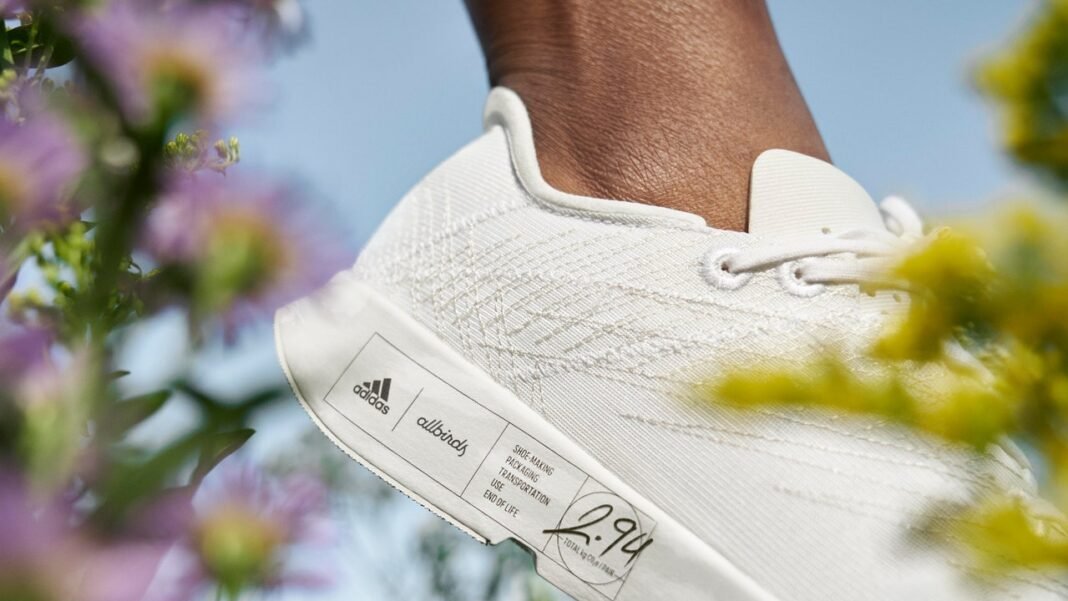
Allbirds was one of the pioneers of addressing the overall carbon footprint of the shoe, already stamping the number on each pair of its Wool Dasher and Dasher Mizzle. For Allbirds, carbon footprint provides a useful target with a sustainability halo effect.
“Carbon is not the only metric to be tracking,” says Kajimura. “But it is one metric that kind of rolled up a lot of other things into it, whether we’re talking about energy consumption, and end of life, manufacturing or transportation.
“It creates a unifying metric that’s objective and scientific. That helps to clarify what can be an ambiguous or complicated topic, and, for now, it’s the best first step.”
This collaboration took the carbon-cutting challenge further. To get the carbon cost down to 2.94kg CO2e/pair, the teams focused on five areas: Shoe making, packaging, transportation, use and end of life.
“At every step of that way, we flexed a different variable to see how the numbers would net out,” says Kajimura. “Maybe there was a more energy-intensive process, but it led to an actual lighter component and the end, so that was better for the carbon footprint. You can turn one knob and everything can go in the wrong direction, and you have to go back. But it was certainly an iterative process.”
So how did they do it?
Shoe making
(2.16kg CO2e/pair)
Manufacture – including raw materials, material manufacturing and assembly – accounts for the biggest chunk of carbon in a shoe’s lifecycle. Material selection plays a big part and in the Futurecraft.Footprint, the uppers use a mixture of natural materials such as Tencel and recycled polyester; the midsole is made from 18 per cent bio-based sugar cane with 82 per cent TPU Lightstrike foam; and the outsole uses 10 per cent natural rubber, blended with additional components in a compound structure that provides the necessary durability, but also allowed the designers to save weight and reduce carbon emissions compared to typical fully synthetic outsoles. The laces are made from 100 per cent recycled polyester. Cutting followed tangram tessellation principles to reduce scrap and waste.
Weight was also a key consideration, and to save it the team removed all internal reinforcements, using embroidered elements to add support only where necessary.
The midsole foam’s lightweight combination of Allbirds sugar-cane based foam and adidas’s proprietary Lightstrike foam, along with minimal rubber outsole pads protecting the key footstrike zones and that minimally-structured mesh, helped keep the shoe’s weight down to just 154g, among the lightest shoes going.
Packaging
(0.32kg CO2e/pair)
The teams not only looked at the shoe box materials, selecting lighter cardboard, but also redesigned the shape of the shoe box itself into a cone to maximise shipping space. Compared to the Allbirds Tree Dasher, the Footprint achieved a 40 per cent reduction in total packaging weight, and the redesigned box means 30 per cent more pairs of shoes can be carried in each carton.
Transportation
(0.09kg CO2e/pair)
According to the Futurecraft.Footprint team, the shipping for this shoe will be over sea, using bio-fuelled vessels “whenever possible”. The carbon calculation takes into account the true shipping method and biofuel credits were purchased for all inbound shipping, which reduces the carbon footprint of transportation.
Use
(0.00kg CO2e/pair)
It’s understandably harder for brands to track what we do with a shoe once it’s in our hands, but the Futurecraft.Footprint LCA states: “According to different guidelines for footwear, maintenance should only be considered when product care activities (such as machine washing and/or drying) are advised by the footwear brand.” For this product, none of those activities were considered.
End of Life
(0.37kg CO2e/pair)
In terms of durability, the two firms say that Futurecraft.Footprint went through the same testing as every other running shoe either companies release and each pair is “expected to hold up similarly to other Adidas and Allbirds performance running shoes” – but that the “exact lifespan depends on wearer’s level of activity”.