
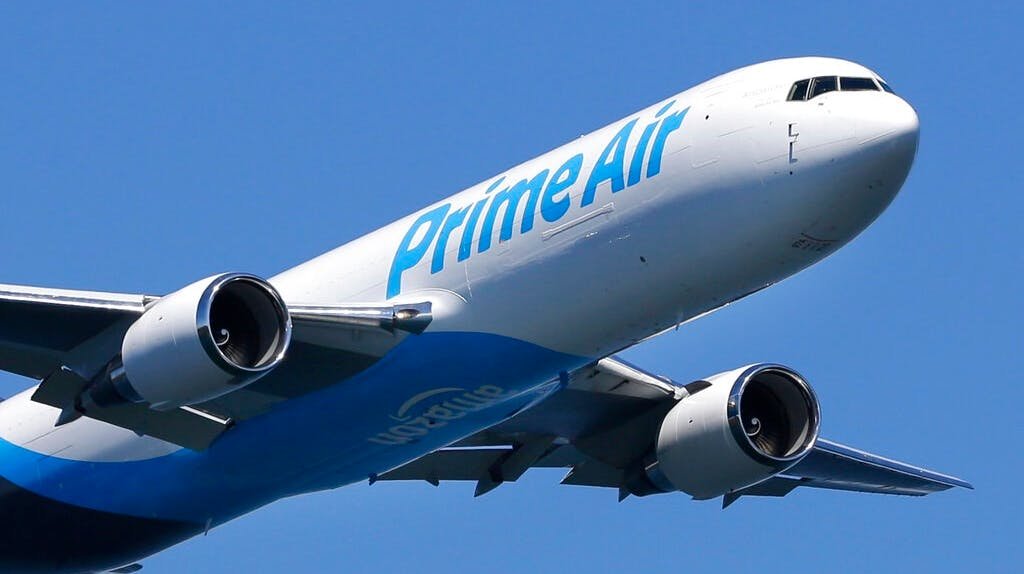
In this Friday, Aug. 5, 2016, file photo, a Boeing 767 with an Amazon.com “Prime Air” livery flies over Lake Washington, as part of the Boeing Seafair Air Show. Amazon said Wednesday, June 30, 2021, that its carbon footprint grew 19% last year as it rushed to deliver a surge of online orders during the pandemic.
AP Photo/Ted S. Warren, File
NEW YORK (AP) — Amazon said Wednesday that its carbon footprint grew 19% last year as it rushed to deliver a surge of online orders during the pandemic.
The online shopping behemoth said activities tied to its businesses emitted 60.64 million metric tons of carbon dioxide last year — the equivalent of burning through 140 million barrels of oil. Amazon’s carbon footprint has risen every year since 2018, when it first disclosed its carbon footprint after employees pressured it to do so.
The Seattle-based company said that, while its carbon footprint grew, the amount of carbon it emitted for every dollar spent on the site fell 16% in 2020.
But the increase in its total carbon footprint shows how hard it is for a fast-growing company like Amazon to cut down on pollution.
The company has been buying up solar energy, making its gadgets out of recycled plastic and even renamed a Seattle hockey arena after its climate-change initiative.
However, Amazon depends on fuel-burning planes and trucks to ship billions of items around the world. In fact, it announced earlier this year that it would buy 11 jets to get packages to shoppers faster. Amazon’s emissions from fossil fuels soared 69% last year.
There was some improvement. Because more people stayed home and ordered online during the pandemic, the emissions from shoppers’ drives to Amazon’s Whole Foods grocery stores fell 32%, the company said.